Getting started#
Quick Installation#
The simple CLIMADA installation only requires the mamba (or conda) python environment manager (look here).
If you are already working with mamba or conda, you can install CLIMADA by executing the following line in the terminal:
mamba create -n climada_env -c conda-forge climada
Each time you will want to work with CLIMADA, simply activate the environment:
mamba activate climada_env
You are good to go!
See also
You don’t have mamba or conda installed, or you are looking for advanced installation instructions? Look up our detailed instructions on CLIMADA installation.
CLIMADA in a Nutshell#
How does CLIMADA compute impacts ?
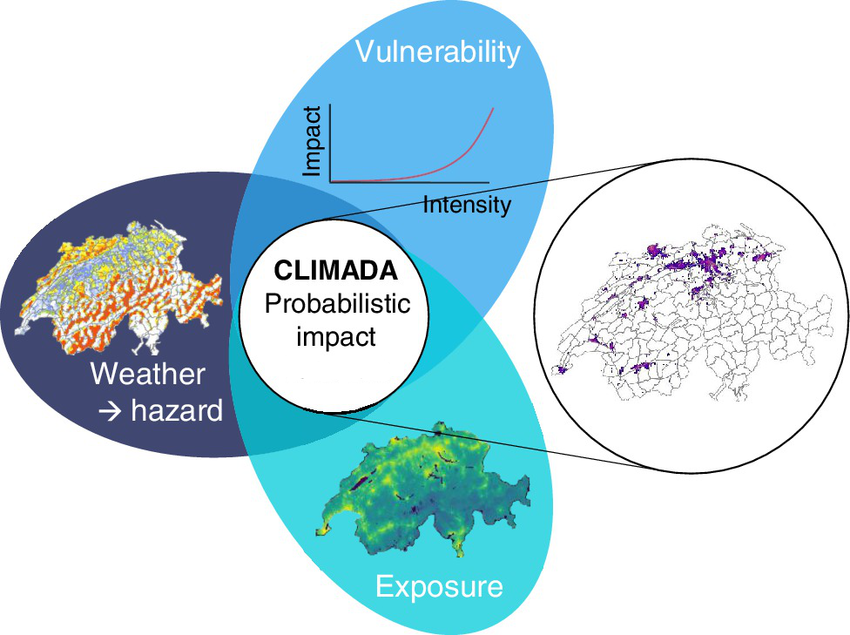
CLIMADA follows the IPCC risk framework to compute impacts by combining hazard intensity, exposure, and vulnerability. It models hazards intensity (e.g., tropical cyclones, floods) using historical event sets or stochastic simulations, overlaying them with spatial exposure data (e.g., population, infrastructure), and applies vulnerability functions that estimate damage given the hazard intensity. By aggregating these results, CLIMADA calculates expected impacts, such as economic losses or affected populations. See the dedicated impact tutorial for more information.
How do you create a Hazard ?
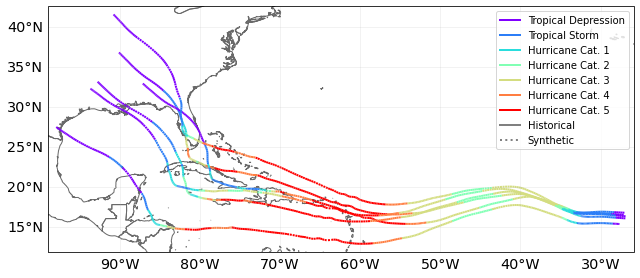
From a risk perspective, the interesting aspect of a natural hazard is its location and intensity. For such, CLIMADA allows you to load your own hazard data or to directly define it in the platform. As an example, users can easily load historical tropical cyclone tracks (IBTracks) and apply stochastic methods to generate a larger ensemble of tracks from the historical ones, from which they can easily compute the maximal windspeed, the hazard intensity.
How do we define an exposure ?
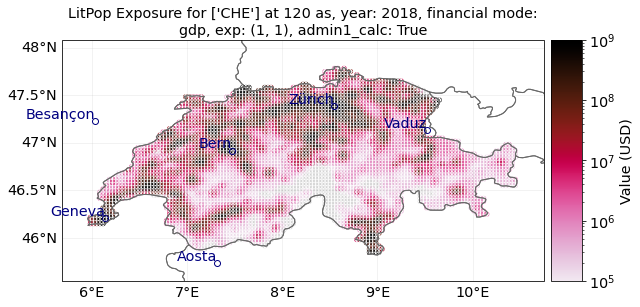
Exposure is defined as the entity that could potentially be damaged by a hazard: it can be people, infrastructures, assests, ecosystems or more. A CLIMADA user is given the option to load its own exposure data into the platform, or to use CLIMADA to define it. One common way of defining assets’ exposure is through LitPop. LitPop dissagrate a financial index, as the country GDP for instance, to a much finer resolution proportionally to population density and nighlight intensity.
How do we model vulnerability ?
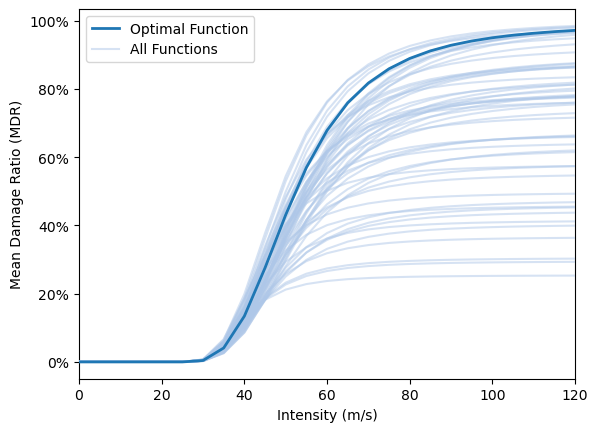
Vulnerability curves, also known as impact functions, tie the link between hazard intensity and damage. CLIMADA offers built-in sigmoidal or step-wise vulnerability curves, and allows you to calibrate your own impact functions with damage and hazard data through the calibration module.
Do you want to quantify uncertainties ?
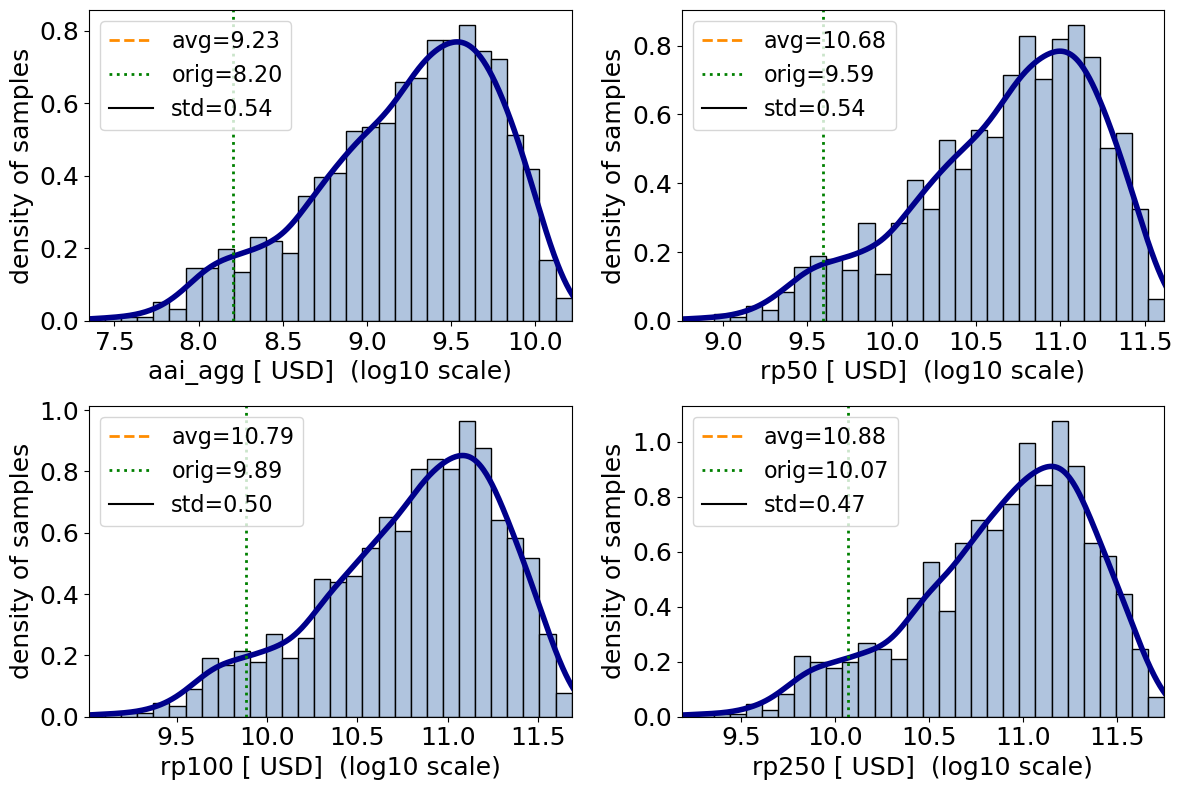
CLIMADA provides a dedicated module unsequa for conducting uncertainty and sensitivity analyses. This module allows you to define a range of input parameters and evaluate their influence on the output, helping you quantify the sensitivity of the modeling chain as well as the uncertainties in your results.
Compare adaptation measures and assess their cost-effectiveness
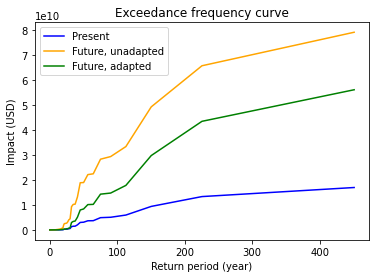
Is there an adaptation measure that will decrease the impact? Does the cost needed to implement such measure outweight the gains? All these questions can be asnwered using the cost-benefit and adaptation module. With this module, users can define and compare adaptation measures to establish their cost-effectiveness.